Marines Deploy Reaper Drones to South China Sea
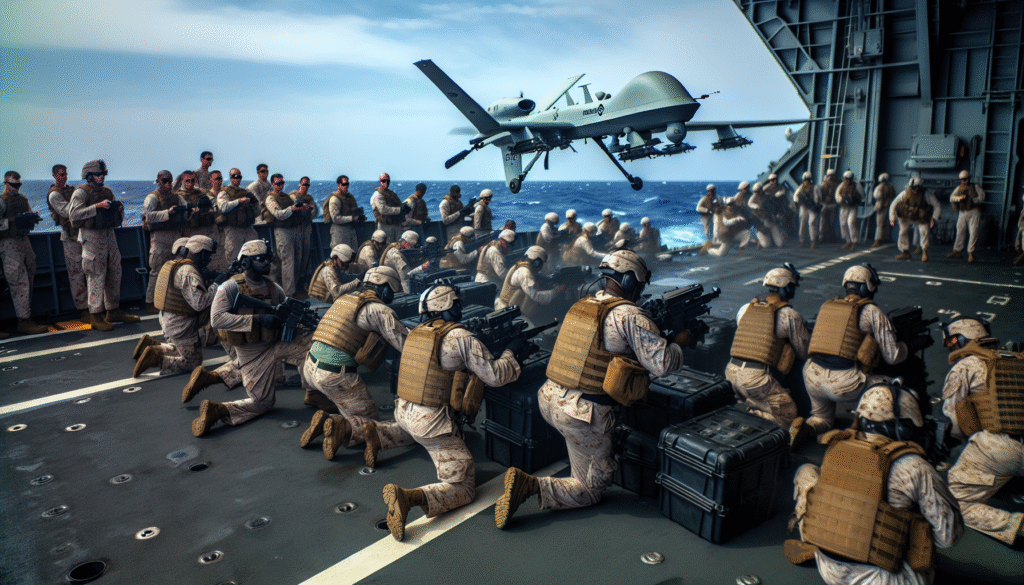
The U.S. Marine Corps has deployed a unit operating MQ-9A Reaper drones to a strategic location in the South China Sea, marking a significant shift in America’s evolving posture toward the Indo-Pacific region. According to the Military Times article titled “Marines deploy Reaper drone unit to South China Sea” published on militarytimes.com, this move underscores the Pentagon’s growing emphasis on unmanned systems and persistent aerial surveillance to counter China’s expanding maritime presence.
The deployment involves Marine Unmanned Aerial Vehicle Squadron 3, also known as VMU-3, which recently began operations from an undisclosed location within Southeast Asia. While specific operational details remain classified, defense officials confirmed the unit’s integration into ongoing joint exercises and reconnaissance missions across the South China Sea — a region fraught with territorial disputes and escalating military tensions.
The MQ-9A Reaper, an advanced remotely piloted aircraft system, is traditionally used by the U.S. Air Force for intelligence gathering, surveillance, and precision strikes. Its integration into Marine Corps missions reflects a broader strategic realignment as the Corps continues its Force Design 2030 overhaul. The force restructure, which includes shedding heavy armor and artillery assets, aims to enable more agile, technologically advanced units capable of operating within contested maritime zones.
Military analysts view the deployment as part of the U.S. strategy to “normalize presence” in contested areas without triggering direct confrontation. “Deploying Reaper drones allows the Marines to gather critical intelligence, enhance domain awareness, and demonstrate continuous engagement — all without placing larger assets or personnel in harm’s way,” said Eric Sayers, a senior fellow at the American Enterprise Institute.
Although the exact operating site was not disclosed due to security concerns, the article notes that the deployment comes on the heels of increased bilateral defense cooperation with regional partners, notably the Philippines. Recent agreements have granted American forces access to key island locations, many with direct sightlines to waterways patrolled by Chinese vessels.
Chinese officials have routinely criticized U.S. military activities in the region, branding them as provocations and accusing Washington of stoking instability. Beijing claims sovereignty over large swaths of the South China Sea — including areas recognized internationally as belonging to other Southeast Asian nations. U.S. officials, for their part, assert that the waters and airspace remain international commons and stress the importance of maintaining a free and open Indo-Pacific.
The use of Reaper drones by Marine forces adds a persistent aerial element to the Pentagon’s operational toolkit, providing an around-the-clock intelligence and surveillance capacity that manned aircraft often cannot sustain economically or logistically. This development further highlights the Marine Corps’ adoption of cutting-edge technologies in preparing for peer-level competition.
While officials have not disclosed the length or scope of the UAV mission in Southeast Asia, sources told militarytimes.com that the deployment is expected to continue indefinitely as part of a rotational presence. The trajectory of such deployments will likely depend on the pace of regional tensions and the outcome of ongoing U.S. diplomatic efforts with both allies and strategic competitors.
As the U.S. military continues to integrate unmanned systems into forward operations, the deployment of Reaper drones is emblematic of its long-term vision for deterrence and strategic presence in one of the world’s most volatile and economically vital regions.