Marine Corps Marks End of Harrier Era
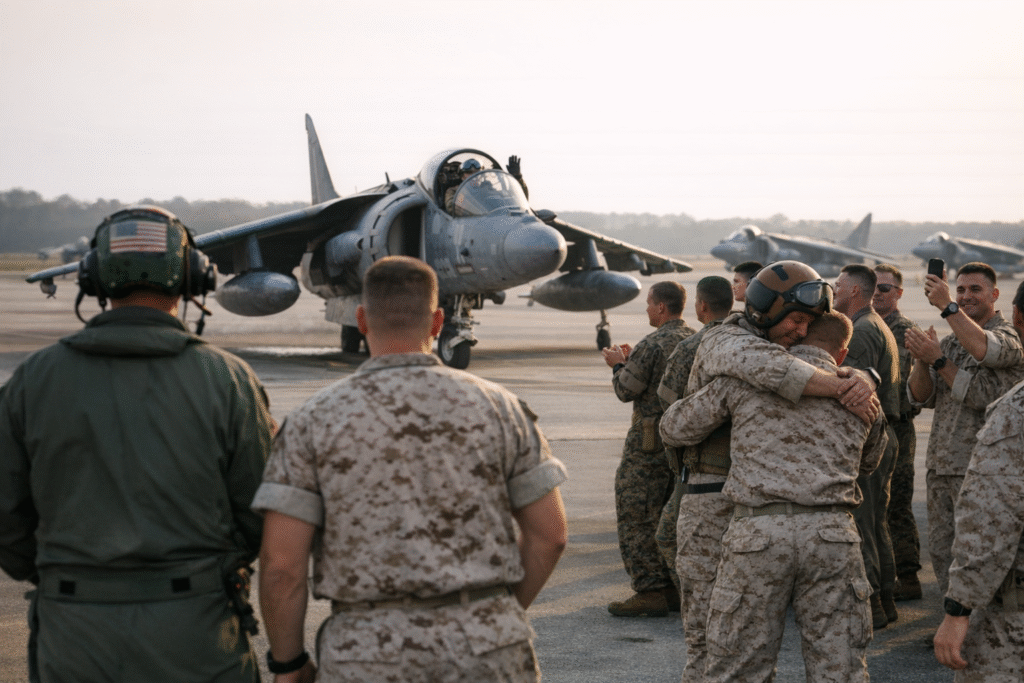
The U.S. Marine Corps is preparing to mark the end of an era as it phases out the AV-8B Harrier, a vertical/short takeoff and landing aircraft that has been central to Marine aviation for decades. As first reported in the Military Times article “Marines to host weeklong Harrier aircraft sundown celebration honoring its legacy,” the service plans to commemorate the aircraft’s retirement with a weeklong series of events highlighting its operational history and the communities that supported it.
The planned observance will bring together current and former aviators, maintainers, and personnel who worked with the Harrier since its introduction into Marine Corps service in the early 1980s. Events are expected to include aerial demonstrations, historical displays, and ceremonies acknowledging the aircraft’s role in conflicts ranging from the Gulf War to operations in Iraq and Afghanistan.
The AV-8B Harrier has long been valued for its ability to operate from austere environments and amphibious ships, offering operational flexibility that distinguished it from conventional fixed-wing aircraft. Its vertical and short takeoff capability allowed Marine units to project air power from locations where traditional runways were unavailable, aligning closely with the Corps’ expeditionary doctrine.
Despite its unique capabilities, the Harrier is being retired as part of a broader modernization effort centered on the F-35B Lightning II, which also features short takeoff and vertical landing technology but incorporates advanced stealth and sensor systems. The transition reflects a shift toward integrating next-generation capabilities across Marine aviation units, though it also marks the loss of a platform that has become synonymous with Marine Corps air-ground operations.
Officials involved in organizing the celebration have emphasized that the event is intended not only as a farewell but also as a recognition of the aircraft’s lasting impact on military aviation. The Harrier’s service life included decades of combat deployments and humanitarian missions, as well as continuous adaptations to evolving mission requirements.
Veterans of Harrier squadrons are expected to play a prominent role in the ceremonies, sharing firsthand accounts of deployments and the aircraft’s performance under combat conditions. Their participation underscores the broader purpose of the commemorative week: to preserve institutional memory as the Corps transitions to newer platforms.
As the Marine Corps moves forward with its modernization strategy, the Harrier’s retirement represents both a technological progression and a moment of reflection. The upcoming events aim to ensure that the legacy of the aircraft—and the personnel who operated it—remains an enduring part of Marine Corps history.