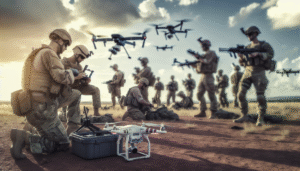
Marine Builds First NDAA-Compliant 3D-Printed Drone

In a significant advancement for the Marine Corps’ technological capabilities, a U.S. Marine has developed the service’s first National Defense Authorization Act (NDAA)-compliant, 3D-printed drone — a breakthrough that could reshape the future of battlefield reconnaissance and supply chain logistics. The development was detailed in the article titled “US Marine designs Corps’ first NDAA-compliant 3D-printed drone,” published by Military Times on February 6, 2026.
Staff Sgt. Matthew Cavanaugh, a Marine assigned to II Marine Expeditionary Force’s innovation cell, successfully created the drone using in-house design and additive manufacturing technology. The project aligns with growing Defense Department emphasis on leveraging advanced technologies to reduce dependency on external supply chains and mitigate potential geopolitical vulnerabilities, particularly those involving Chinese-manufactured components.
The NDAA, which imposes restrictions on the acquisition of certain foreign-made technologies due to cybersecurity and intelligence concerns, prohibits the Department of Defense from procuring drones or drone components originating from adversarial nations. By ensuring full compliance with these restrictions, Cavanaugh’s drone represents an important milestone in the military’s broader strategy to develop secure, domestically sourced capabilities.
Built using open-source software and 3D-printed materials sourced entirely within the U.S., the drone’s low cost and modular design provide a modern solution to meet evolving tactical needs without sacrificing operational security or violating federal procurement laws. According to Military Times, the drone can be produced for under $1,000, a fraction of the cost of many commercially available systems.
Critically, the device is not just a prototype—it has already undergone flight testing and shown both reliability and adaptability. Its performance in field exercises suggests the potential for future deployment in reconnaissance missions, where low visual and acoustic signatures contribute to its tactical utility. The Marines involved in testing also highlighted the drone’s ease of repair and customization, enhancing its suitability for front-line units operating in dynamic and austere environments.
The development follows a broader push within the U.S. military to expand indigenous prototyping efforts. With evolving threats and an increasingly contested technological landscape, in-house innovations like Cavanaugh’s drone reflect a growing preference for agile, soldier-led problem solving. The Marine Corps’ willingness to embrace such innovation echoes recent directives encouraging field units to explore practical applications of emerging technologies, particularly when they enhance lethality, survivability, or command and control.
While the drone is not yet in full-scale production, the innovation team within II MEF has already expressed interest in refining the design and testing additional capabilities. Cavanaugh’s work has drawn attention from both senior Marine Corps leaders and defense acquisition officials, potentially paving the way for broader adoption across other branches and units.
As the Pentagon continues its efforts to shore up its technological base amid intensifying scrutiny of foreign supply dependencies, Cavanaugh’s NDAA-compliant drone offers a compelling model for what the future of military innovation may look like: fast, flexible, and forged at the ground level by those closest to the fight.