Coast Guard Seeks New Laws for Autonomous Vessels
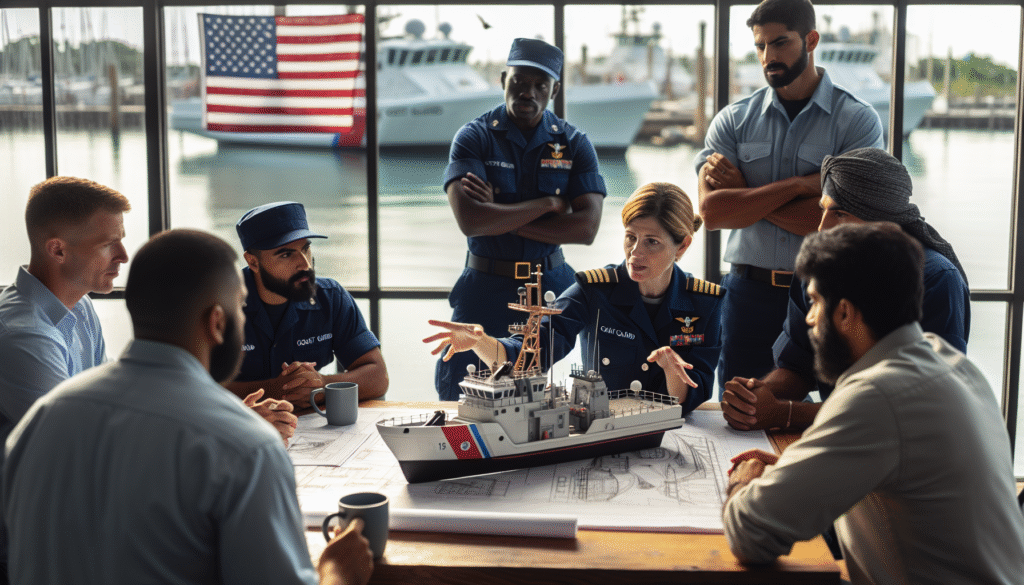
As the U.S. maritime domain confronts rapid technological shifts, the U.S. Coast Guard is urging Congress to provide updated legal and regulatory frameworks to manage growing fleets of drones and autonomous vessels, according to a report published by DefenseScoop titled “Coast Guard seeks updated laws to regulate drones, autonomous vessels during Congressional hearing.”
At a recent Congressional hearing focused on maritime innovation and preparedness, senior Coast Guard officials warned that existing statutes are insufficient to address the operational and legal complexities introduced by unmanned systems and artificial intelligence-driven platforms. These technologies, which promise enhanced surveillance and mission efficiency, are already being tested and in some cases deployed across Department of Homeland Security and Department of Defense operations. However, maritime laws remain largely tailored for conventional, crewed vessels.
Rear Admiral Wayne Arguin, the Coast Guard’s Assistant Commandant for Prevention Policy, emphasized the growing mismatch between emerging capabilities and legacy regulatory systems. “As technology rapidly evolves, our statutory authorities and regulations must evolve in parallel,” Arguin testified. He further noted that without updated laws, the Coast Guard faces limitations in enforcing standards for systems that operate without human crews and may cross jurisdictional boundaries autonomously.
The Coast Guard’s request comes amid increasing adoption of unmanned surface vessels (USVs) and aerial drones in commercial and government maritime operations, including port security, fisheries enforcement, and environmental monitoring. Lawmakers from both parties acknowledged the urgency, expressing particular concern over vulnerabilities in critical infrastructure and the potential for adversarial use of similar technologies.
During the hearing, legislators and service officials also discussed how the proliferation of artificial intelligence in unmanned systems could complicate accountability in the event of accidents, collisions, or violations of international law. Particular emphasis was placed on defining liability and operational control in scenarios involving machine decision-making without real-time human oversight.
While members of the House Transportation and Infrastructure Committee expressed broad bipartisan support for updating maritime regulations, specifics on forthcoming legislation remain uncertain. Still, lawmakers pledged to work closely with the Coast Guard and other maritime stakeholders to draft updates that ensure safety, sovereignty, and the responsible adoption of emerging capabilities.
The December hearing marks one of several recent efforts by government institutions to reconcile legacy governance structures with a rapidly modernizing technological landscape. As maritime operations become more automated and data-driven, the Coast Guard is positioning itself not only as an enforcer of maritime law but also as a key stakeholder in shaping the future terms of that law.
According to DefenseScoop’s coverage, the Coast Guard has already begun experimenting with drone and autonomous vessel technology, underscoring the operational urgency of updating statutory authority. Officials indicated that without expanded and clarified powers, the service will remain constrained in its ability to supervise maritime innovation while ensuring public safety and regulatory compliance.
As autonomous technology continues to reshape maritime operations, the law will need to adapt swiftly—or risk becoming a constraint, rather than a safeguard, in complex and increasingly automated seas.