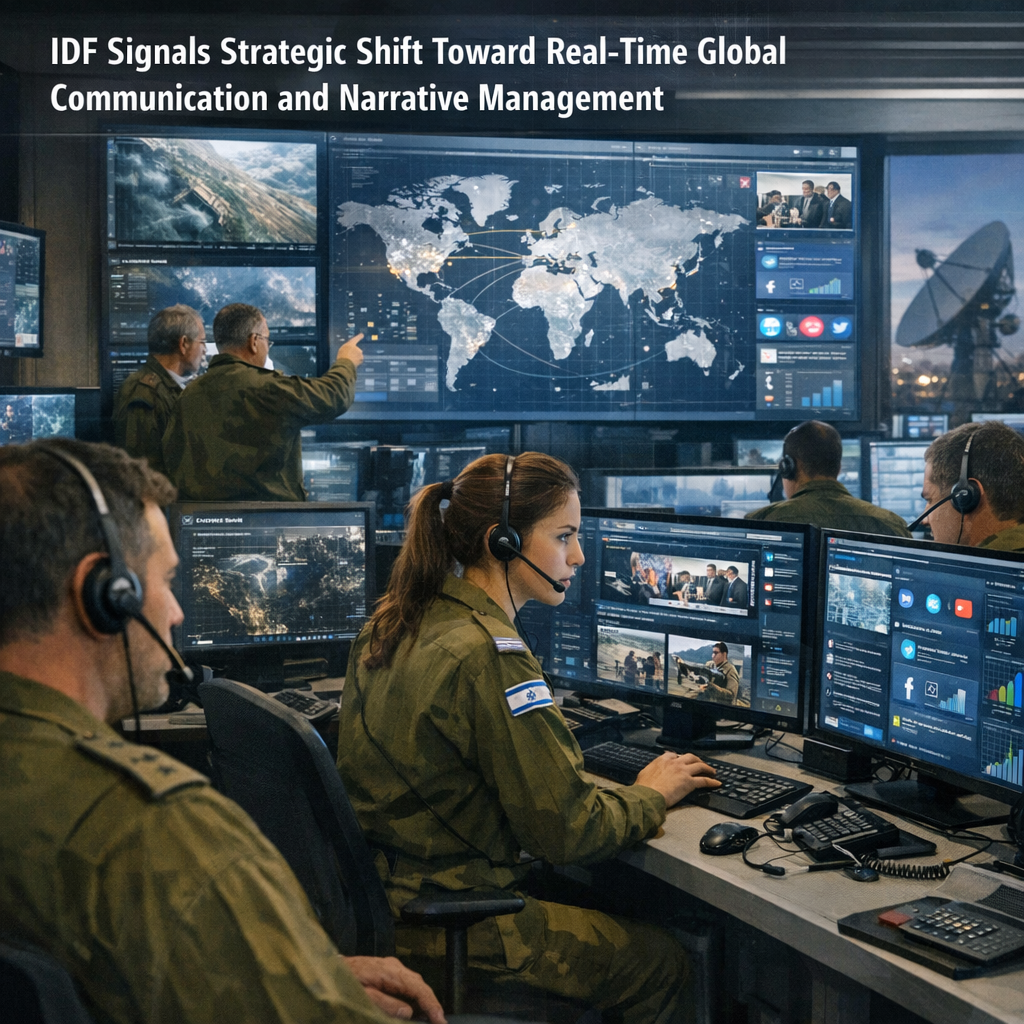
IDF Signals Strategic Shift Toward Real-Time Global Communication and Narrative Management
The Israeli military’s approach to international communication is entering a new phase as it confronts an increasingly complex global information environment, according to a recent interview published by i24NEWS titled “i24NEWS Sits Down with the New IDF International Spokesperson”.
In the interview, the newly appointed international spokesperson for the Israel Defense Forces (IDF) outlines a strategy that places greater emphasis on real-time engagement, transparency, and responsiveness to global audiences. The role, which has grown in prominence in recent years, reflects the IDF’s recognition that public perception abroad is now an integral component of modern military operations.
Speaking to i24NEWS, the spokesperson described the challenge of conveying military actions to diverse international audiences operating across different political, cultural, and media landscapes. The position requires balancing operational security with the demand for immediate information, particularly during periods of heightened conflict, when narratives can rapidly take shape online and across traditional media.
The interview highlights the growing importance of digital platforms in shaping global opinion. According to the spokesperson, the IDF has expanded its use of social media and multilingual communication channels to reach wider audiences more directly, bypassing traditional gatekeepers. This shift is intended not only to disseminate information quickly but also to counter misinformation and competing narratives that can emerge during crises.
At the same time, the spokesperson acknowledged the limitations inherent in strategic communication during active military operations. While the IDF seeks to provide timely updates, certain details must remain classified, creating an ongoing tension between openness and security. Managing that tension, the official suggested, is central to maintaining credibility with international audiences.
The conversation also touched on the broader geopolitical context in which the IDF operates. Israel’s military actions are subject to intense scrutiny from governments, international organizations, and advocacy groups, including bodies like the United Nations, making the role of an international spokesperson particularly sensitive. The spokesperson indicated that part of the job involves engaging not only with journalists but also with diplomats and policy stakeholders, reinforcing Israel’s perspective in global discussions.
In the i24NEWS interview, there is a clear acknowledgment that communication is no longer a secondary function of military activity but a strategic domain in its own right, a concept also explored in frameworks like NATO’s strategic communications doctrine. The spokesperson emphasized that public understanding of IDF operations can influence diplomatic outcomes and shape the environment in which military decisions are received.
The appointment comes at a time when information flows are faster and more contested than ever. As conflicts are increasingly accompanied by parallel battles over narrative and legitimacy—often described as information warfare—the effectiveness of roles such as the IDF’s international spokesperson may prove critical in determining how events are interpreted far beyond the immediate theater of operations.
By foregrounding transparency, speed, and adaptability, the new spokesperson signaled an effort to refine how the IDF presents itself to the world—an endeavor that reflects broader shifts in how modern militaries engage with global public opinion.