Protecting Vulnerable Tankers in Contested Airspace
As adversary nations continue to bolster their air defense capabilities with increasingly advanced missile systems, the U.S. military is facing urgent pressure to develop and implement stronger protective strategies for its large, slow-moving aircraft. A recent report published by Breaking Defense under the title “Enemy Missile Defense Is More Capable, So Larger, Slower Tankers & Lifters Need Better Protection” highlights the vulnerability of critical aerial assets such as tankers and airlifters in potential future conflicts against near-peer competitors like China or Russia.
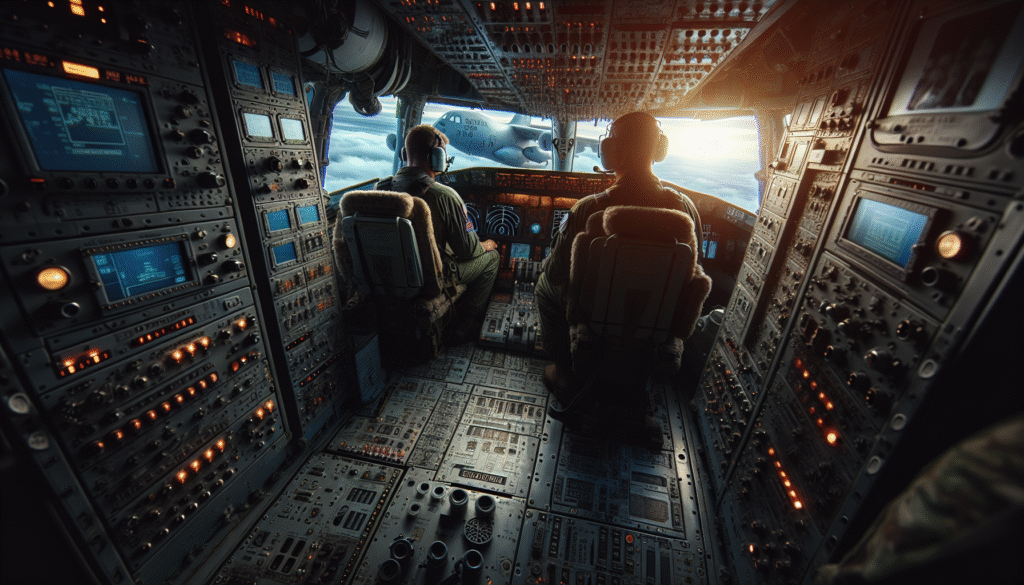
The article underscores a central concern reverberating through the Pentagon and among allied military planners: while agile fighter jets are designed to penetrate and operate within contested airspace, platforms such as the KC-135, KC-46, and C-17 are far less suited to such hostile environments. These aircraft, essential for refueling and strategic mobility, risk becoming high-value targets in a battlespace increasingly saturated with sophisticated surface-to-air missile (SAM) systems and integrated air defense networks.
Current thinking within military circles suggests a pivot is necessary—away from a Cold War-era assumption of air superiority and toward operating in what strategists now refer to as ‘contested logistics.’ Speaking to Breaking Defense, officials and analysts noted that, without better protection or significant doctrinal changes, the traditional air mobility fleet could be rendered ineffective or even grounded in a high-intensity conflict scenario.
Among the protective measures under consideration are both kinetic and non-kinetic solutions. These range from the deployment of long-range standoff weapons capable of neutralizing threats before tankers arrive in theater, to more ambitious concepts such as escorting vulnerable aircraft with armed drones or integrating advanced electronic warfare systems to obscure or mislead enemy radars. A more radical long-term vision includes developing entirely new tactical airlift and refueling platforms that can operate at higher speeds, lower observability, or even autonomously.
Yet even as these options are explored, there is acknowledgment within the Pentagon that technology alone will not solve the problem. Operational concepts must evolve in tandem. Officials note that this may involve dispersing air refueling operations in a more decentralized manner across the globe, using austere or forward operating bases closer to combat zones, and increasing reliance on host-nation support to minimize exposure time in hostile airspace.
The report further points to the Department of Defense’s planned investments in survivability enhancements. Programs such as the Next Generation Air Refueling System (NGAS) and Agile Combat Employment (ACE) are being recalibrated to adapt to these emerging realities. However, these initiatives are still years from fruition and, as the article suggests, may struggle to keep pace with the rapid deployment of adversary systems designed explicitly to counter the U.S. military’s long-standing expeditionary advantages.
In particular, China’s anti-access/area denial (A2/AD) strategy looms large in these calculations. With a suite of long-range precision weapons including the DF-21D and DF-26 missiles, the challenge of inserting and sustaining forces into the Indo-Pacific theater becomes markedly more severe. Tankers and cargo lifters—once seen as logistical afterthoughts in the shadow of stealth aircraft—are quickly becoming focal points of strategic planning.
As the U.S. grapples with the constraints of its current force structure, defense leaders are recognizing that air dominance can no longer be presumed. The protection of critical enablers like tankers and airlifters is taking a central role in future operational planning, forcing a reexamination not only of technology and tactics, but of the foundational assumptions that have guided American airpower for decades.